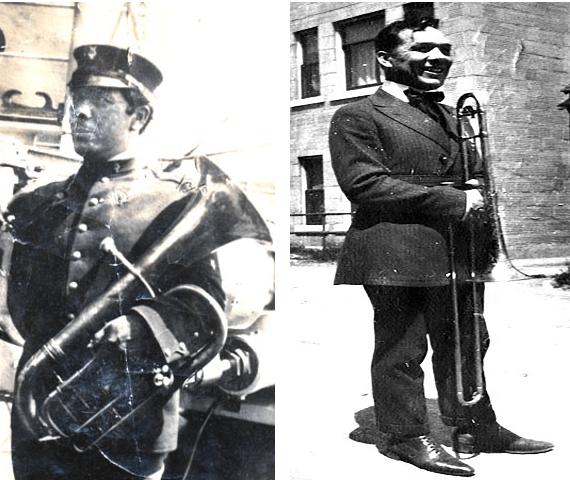
— by Isabel Robertson
Born on April 4, 1884 on the Puyallup Indian Reservation, William Arquette would become an influential musician in Tacoma and surrounding regions. He was a talented multi instrumentalist playing the trombone, trumpet, cornet and sousaphone. William Arquette’s musical journey began at the Cushman Indian School. The school systems were cruel and demoralizing, yet Arquette found joy in the bands on the reservation. It was Arquette’s music teacher Henry J. Philips who taught Arquette all about music, especially the trombone. Philip stated that he took playing with ease and had a natural ability with the trombone.
Arquette’s long career began with the Cushman band. The band performed at several significant events in the 1890s, including an Independence Day celebration in 1891 which aimed to create a general reunion of Western Washington tribes on Puyallup lands. Two years later the school band participated in a parade welcoming Vice President Adlai E. Stevenson to Tacoma, and their presence was noted as they played “Hail to the Chief” during Stevenson’s departure for Olympia. These events showcase the active involvement of the band in various significant celebrations and occasions during the late 19th century.

In 1904, Arquette joined the United States Indian Band, which comprised top musicians from various reservation bands across the country. The band participated in the Louisiana Purchase Exposition, where they achieved second-place in an international competition. During this time the renowned band leader John Philip Sousa formed his own band and recruited exceptional musicians, including Arquette. The trombonist gained the stage name “Chief Arquette” during his time with Sousa’s band. He also played the sousaphone, which is a marching band bass instrument which Sousa participated in developing.
In 1916, Arquette was reconnected with his siblings and childhood friends from Cushman School when he settled in Tacoma again. During this time, He joined several bands, the first being Tacoma’s American Federation of Musicians band. From 1920 to 1921, Arquette was a member of Dad Wagner’s Band, a prominent musical ensemble in Seattle. Additionally, he was part of the New Pantages Theatre Orchestra in Seattle, backing performances by renowned vaudeville stars. Arquette’s career also led him to join various musicians’ unions, where he garnered press attention. Notably, he became the trombone player in George Olsen’s popular octet, a top dance band in Portland. His lively career was pulling him in several different directions.

During the 1920’s his career was still going strong and pulling him in multiple directions away from home. In 1923, Arquette ventured to New York City to join the renowned orchestra of Paul Whiteman, often referred to as New York’s “King of Jazz.” During the 20’s Paul Whiteman rose to fame and had a large reputation among the musical community. Thanks to Arquette’s relationship with Whiteman, he secured a position with the house band at the Apollo Theatre.

After his time in New York, Arquette returned to the western United States, eventually arriving in Montana. There, in 1924 he became a member of the popular Ernest Loomis Orchestra. He even offered music lessons on sousaphone, trumpet, and trombone. In 1927, the Loomis orchestra was recorded by New York’s Victor Records, resulting in the release of two tunes, “Sentimental Rose” and “Lovers Lane,”. The orchestra also notably performed at Butte’s Winter Garden Palace and made appearances, at studios in Seattle.
Returning to Seattle, Arquette continued his musical pursuits, securing gigs with renowned dance bands. He notably played with the Frankie Roth Orchestra at the legendary Spanish Castle ballroom. During the challenging years of the Great Depression, Arquette supplemented his income by hand-winding bead decor on bamboo fishing poles, while his family engaged in traditional tribal beadwork as a side business. In 1939, he participated in Seattle’s Golden Potlatch celebrations as “Chief William Arquette of the Puyallup Tribe,” donning a Plains Indian feathered headdress and showcasing his musical talents at the Civic Auditorium.
In the 1940s, he became the third chair trombonist with the Seattle Symphony Orchestra, participating in the renowned concerts conducted by the controversial British guest conductor, Sir Thomas Beecham. Additionally, in the early years of World War II, Arquette performed in numerous concerts for shipyard workers and military personnel. True to his declaration that he would continue playing music until his last day, William Arquette remained dedicated to his music. June 16, 1943, he passed away after collapsing during a performance at the Puget Sound Naval Shipyard. His obituary from the local newspaper can be seen below.

As a talented musician, Arquette left a lasting impact on Tacoma’s music scene. Arquette was an incredible multi-instrumentalist who enjoyed a long and varied career in music which took him to many different regions in the United Sates. Despite all those opportunities, William Arquette always came back home.
For more information on William Arquette, visit HistoryLink: Arquette, William “Chief” (1884-1943) – HistoryLink.org
About the Author
Isabel Robertson prepared this article as her final project for TARTS 225: Musical History of Tacoma, taught by Kim Davenport at the University of Washington, Tacoma. At the time she took the class in Spring Quarter 2024, she was a sophomore.
 Tales of Tacoma