–by Liza Svyrydovska
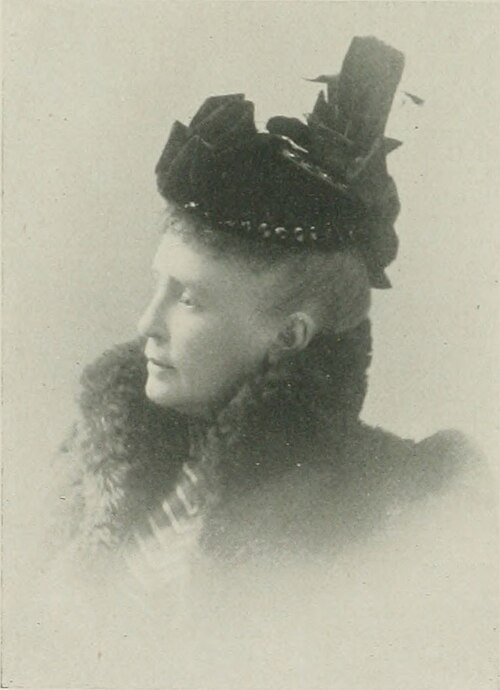
Can you imagine a person present at every significant occasion in a small city? Somebody who would be there during town meetings, parent teacher conferences, school events, weddings, and even funerals? A string tying these events together is music. Logically the one present at these events would be a musician. Yet, the one I want to introduce to you today is so much more. Welcome the woman, the myth, the legend – Tacoma’s music supervisor Lucy Lamson.
Lucy Lamson was not a Tacoma native; she was born June 19, 1857 in Albany New York. She earned her teaching degree from New York State Normal School in Albany in 1886, but she didn’t start working right away to receive more guidance from teachers in New York City. In 1888 Annie Wright Seminary in Tacoma, Washington offered Lucy a teacher position – she accepted and moved to Tacoma. Everything seemed to be picture perfect now – a young and promising teacher is teaching in a private school for girls waiting for a charming someone to bring forth a marriage proposal. As nobody can predict the next shape of a cloud, nobody was able to predict Lucy’s next moves.

Lucy Lamson got entangled in land speculations! Just imagine, in 1888 to 1889 a woman borrowed money, bought city lots and sold them at a profit! Brace yourself – in 1889, she filed a timber claim in Skamania County, Washington. As soon as the school year ended in June, Lucy moved all her belongings to her claim and resided there for six months to legally obtain a title deed for that land. Lucy Lamson didn’t want to become a timber baron; as soon as she lawfully claimed her timber and land deeds she sold both, making a generous profit. That profit was used to fuel her next real estate investment, which resulted in a lucrative income as the city of Tacoma gained popularity. Lamson became a well-off businesswoman, who could live on her own terms.
Those terms included being more than a businesswoman. Around 1896, Lucy Lamson became a supervisor of music across all Tacoma’s grade schools. The hurricane named Lucy Lamson would not stop at doing the bare minimum. As part of her job, Lucy would give special lessons to teachers from first to eighth grades on how to teach music in an age-appropriate way. She would host other musical instructors and arrange for students to take lessons with them. Lamson wrote and presented a paper on “High School Music.” It would take a much longer blog post to tell about everything that Lucy did, but time is limited so the story I can tell you is limited as well.


I will not forgive myself if I don’t tell you that by 1918, Lucy Lamson was known throughout the Northwest region as the director of public-school music. A multitude of events that included music were touched by her guiding hand. Around three hundred teachers worked with Lucy Lamson to bring forth a new musical education plan. Lucy Lamson proposed, implemented and perfected sight singing of two, three and four-part standard choruses. Her students boasted an in-depth knowledge of patriotic and war songs. Children’s choirs were organized to sing at community events along with orchestra and soloists. However, Lucy did not force children into singing – she lured them in with concerts, lectures and recitals given by known Tacoma musicians that formerly attended the same schools as those children.
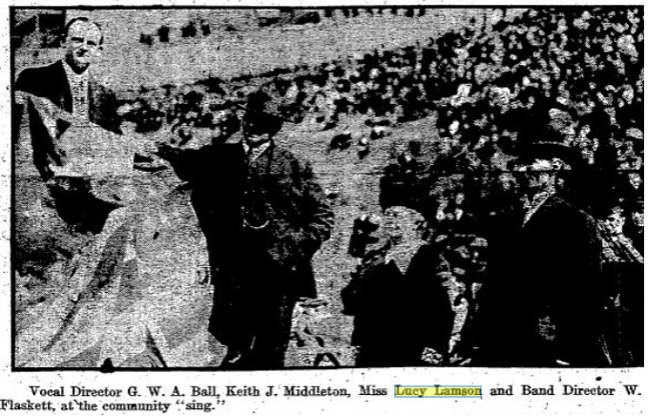
One of the events Lamson helped to organize was the first community “sing” in the Stadium in 1914. Eight thousand people came together to sing patriotic songs, religious hymns, and heartfelt folk melodies. It is important to note that a school children’s choir led by Lucy sang a patriotic song – Soldiers’ Chorus, from “Fanst.” This community sing was not the last one and the choir continued to delight Tacomans with their beautiful singing. As you can imagine, each event was made possible with the musical support from Lucy Lamson and her choir.
As a director of public-school music, Lamson was very serious when it came to musically gifted children, no matter their skin color. As an example, she ensured that a “colored” student, Miss Florence Richardson, would find her way to the historically black Fisk University to continue her musical training after getting her start as a singer in the Tacoma schools. Lamson arranged a fundraising event in September 1913, attended by many prominent Tacomans, to raise the funds necessary to support Richardson’s continued vocal studies.
Lamson was also a proud member of the Daughters of American Revolution who used her knowledge of music to create and present musical programs during the meetings of the club. However, this was not the only club she attended. Lucy Lamson was partial to card games, and was an important member of Eureka Rebekah Card Club, hosting the meetings for the enjoyment of everyone. She also did not abandon her work as a businesswoman. Lamson received attention in the local newspapers when she was the first farmer to employ a “fruit evaporator” on her farm in the Yakima Valley, to be able to process her peaches if the market price for them dropped. Then, she could store them and sell her dried peaches when the price went back up.

If you can share my excitement as to why Lucy Lamson was so amazing, I did my job well. If you are not convinced, let me add the conclusion. Lucy Lamson started as a music teacher. She moved across the country to a barely developed state. In this foreign place, she thrived. Lamson made a small fortune, but did not stop investing, farming and growing her business. She did not quit music either. She became a leader who led generations of children to love music, love performing, and to be respectable members of the society. Lucy did not judge people by their skin color, instead she looked at their talent and who they could become. At the same time, she led an active social life as a church member, a patriot, occasionally played cards, hosted dinner parties and enjoyed life. Do you see it now? She left her mark everywhere in Tacoma.
About the Author
Liza Szyrydovska prepared this article as her final project for TARTS 225: Musical History of Tacoma, taught by Kim Davenport at the University of Washington, Tacoma. At the time she took the class in Spring Quarter 2025, she was a senior majoring in Biomedical Sciences.
 Tales of Tacoma