–by Jesse Miller
The New Yorker Cafe was, throughout its life, a hub to countless events, dinners, conferences, dances and most especially, live music in Tacoma. If you wanted music, this was the place. If you wanted to host an event, this was also the place.
The New Yorker Cafe announced its grand opening in the Tacoma News Tribune on October 26th, 1946 following an “open house” a week before. The official grand opening took place on October 27th, 1946 at Sixth Avenue & Cushman in Tacoma. The New Yorker Cafe was originally started by a Tacoman duo: Michael DeVoto and Ted Clark. DeVoto, the main operator, born in Italy and raised in Tacoma, initially pursued a career in boxing but was not successful; he then worked in the local restaurant industry for many years before the New Yorker was opened. In advertisements for its grand opening, the New Yorker was initially marketed as “Tacoma’s newest, largest and most unique popular priced restaurant.” It specifically served to cater “Bridge Luncheons,” “Special Parties,” and banquets. The marketing in the newspaper also highlighted the New Yorker’s stainless steel kitchen and modern appliances, promoting cleanliness. The advert even invited the public to inspect its kitchen. This shows that cleanliness and efficiency were main selling points in addition to its large capacity.
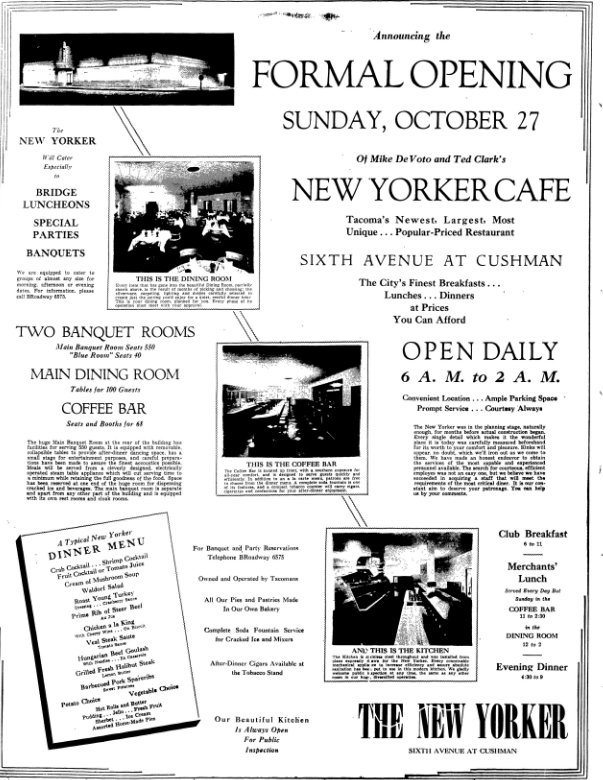
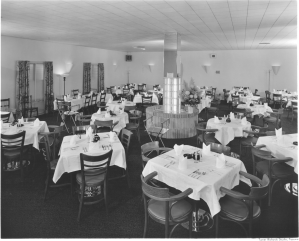
The newspaper marketing also exhibited its two main banquet rooms, its main dining room and their “coffee bar”. The main banquet room had a serving capacity of 550 guests. This capacity made it very popular for many events over the course of the New Yorker Cafe’s life. This picture below shows the original main dining room that was advertised to serve up to 100 guests. A main focal point of the dining room was the circular pillar in the middle which also served as a wishing well around it.
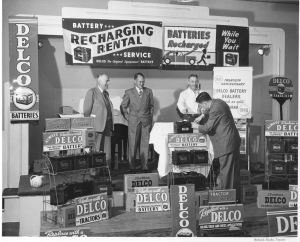
The banquet rooms were often used for the main events. For example, it was used often for celebration events and banquets for a wide variety of groups and occasions over the course of its life. One example was in August 1948 the New Yorker hosted some representatives from the Puget Sound Auto Electric Company for their “Delco” car batteries. A photo of the Delco representatives can be seen below.
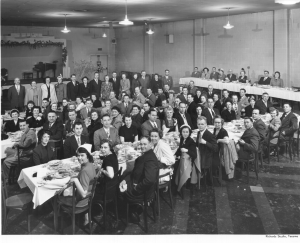
Another example was in 1950 when the New Yorker Cafe was host to a banquet for a public speaking course. The course was taught at the Knapp business college in Tacoma. The banquet is shown below.
Early on, despite the numerous amount of banquets, dinners, speeches and events happening at the New Yorker, it was not without some significant troubles. For example, early in its history, on an early morning in January 1948, a lone waitress named Minerva Barnes entered the New Yorker at 5:30 AM, thirty minutes before the opening time. Shortly after letting herself into the restaurant, she found herself quickly face to face with two armed criminals who demanded the cash register open. The two criminals robbed the register and cracked the safe located within the New Yorker Cafe, stealing $3500 in cash or nearly $47,000 in 2026 dollars. On the same day, police had recovered almost half of the money ($1700). The two criminals were caught after a small gun fight in their home in Tacoma. By mid-february, it was revealed they were sent to state penitentiary for fifteen years each, after the detectives were determined to make them an example for the gun fight that occurred during the arrest. A little over a year later, on May 25th, 1949, the New Yorker Cafe was robbed again during the evening. The robber robbed the register for $705, and had fled the scene before any patrons of the Cafe knew. That same year, they would be further robbed two more notable times, one of the times being rumoured to be the same robber from the previous May who then stole another $500. It was somewhere during this time the New Yorker began to be owned primarily by Mike Devoto and his wife Patty, as they began to be mentioned more in the operations of the New Yorker during articles of mention. Available sources do not clearly show what became of Ted Clark’s share and involvement in the operation of the New Yorker.
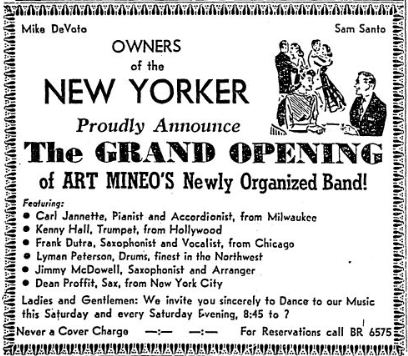
After years of lunches, events, dinners, the New Yorker Cafe on November 9th, 1951 announced it had finished a complete remodel of the facility and some changes. The biggest changes were the “addition” of the new Manhattan Room, The Staten Room, Long Island Coffee Shop and the Coney Island room which was to serve as the venue’s “heart of life, laughter and music.” The Coney Island room had a seating capacity of 350, a trundle stage that could be rolled from under the permanent stage for used by performers, and a spacious hardwood floor made for dancing. A new feature of this remodel was the addition of “big-time band music” and nightly floor shows for patrons. For the musical house band, the New Yorker recruited Art Mineo’s band, “Sweet Swingers”. In the new remodel of the New Yorker, there was something for everyone. The new grand opening was slated for November 16th, 1951 at 9pm, showcasing its new band and show.
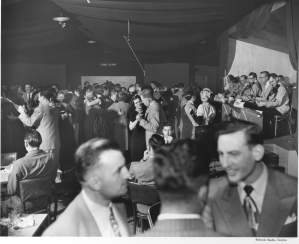
The photograph above showcases the new “Coney Island” room full of dancing patrons to the music from the Art Mineo band to the right in the picture sometime after the opening of the remodel.
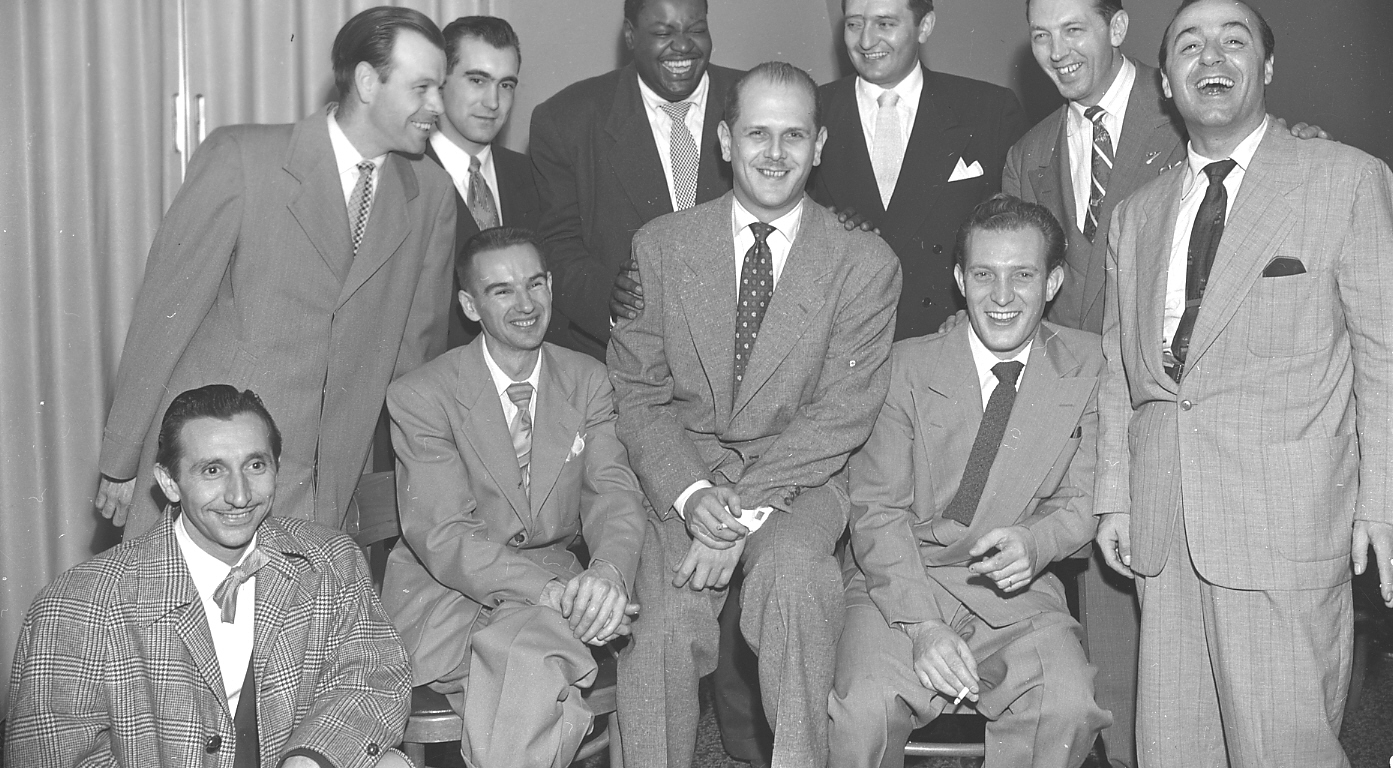
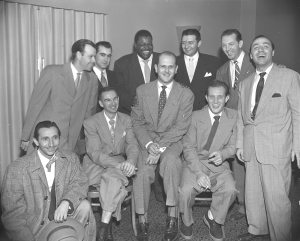
The picture below shows the Art Mineo’s band, with Mineo kneeling on the left alongside notable guest Oscar Peterson in center, joined by Bill Harris and “Flip” Phillips, center and right of picture respectively. The guests called and joined Art Mineo’s band for the opening night of the remodel to play music, playing all night until closing time. Oscar Peterson would go to become considered one of the greatest jazz pianists of all time, later winning seven Grammy Awards. He was seen often playing with his own Oscar Peterson trio across the world. In the photo above left of page, Oscar Peterson can be seen here playing piano, with Art Mineo on bass, Flip on saxophone and Bill Harris on the right with his trombone. Flip and Harris were visiting the New Yorker while playing in Seattle. This backdrop of music was a great night in the history of the New Yorker Cafe and was a change from its past. In 1956, Art Mineo’s band would get a refresh, continuing to play at the New Yorker now with a 7-piece band instead of an 11-piece “orchestra”. Art Mineo would serve as one of the main bands of the New Yorker for many years. It was in November 1969 that Art Mineo reached a 20 year mark of performing at the New Yorker, who then was playing with his quartet 3 days a week.
Throughout the 1950s, many entertainers and notable people had appeared at the New Yorker. Among them was then-Senator John F. Kennedy during the spring of 1954 to address Democrats in the Tacoma area. Stan Boreson, “King’s TV Star” had a notable appearance in January 1955, who appeared in multiple KING shows. It was for a short brief of time during the 1950s the New Yorker was also operated by Sam Santo.
In the later portion of the New Yorker’s life, the jazz spotlight and focus had shifted to be more contemporary. Beginning sometime in February 1974, the New Yorker dropped “the Lawrence Welk style entertainment for the Mick Jagger crowd” and leaned more into the rock and roll, nightlife vibe according to Art Thiel. This marked the shift away its older family-friendly vibe (that Lawrence Welk is known for) and an appeal towards a younger demographic with performances from local rock acts. The venue still hosted many events during this time, but gone were the days of Art Mineo for the most part.
On January 18th 1976, Michael DeVoto, founder of the New Yorker Cafe died at 71. DeVoto’s death unfortunately signaled the beginning of the end. Less than two years later, it was sold in December 1978 from the DeVoto family to the Ide’s. After the New Yorker was sold, it would go under a lot of different names. It was converted into a dinner theater to open called the “Falstaff Dinner Theater” which was in tandem with the restaurant called the “Backstage Restaurant”. The Falstaff Dinner Theater lasted until the April of 1983, when it was sold to a medical supply company, then a couple of years later it was established as a Salvation Army as it is today.
The New Yorker Cafe was once a central part of Tacoma’s music and social scene. It was one of the most popular places to go for events and meetings in the city. It left a profound impact on the Tacoma’s music history and overall cultural history.
Photographs courtesy Tacoma Public Library Image Archives.
About the Author
Jesse Miller prepared this article as the final project for TARTS 225: Musical History of Tacoma, taught by Kim Davenport at the University of Washington, Tacoma. At the time he took the class in Winter Quarter 2026, Jesse was a senior majoring in Accounting.

